
 Blog
Masjid Aisha (Masjid al-Taneem): What It Is, Why It Matters and How to Visit
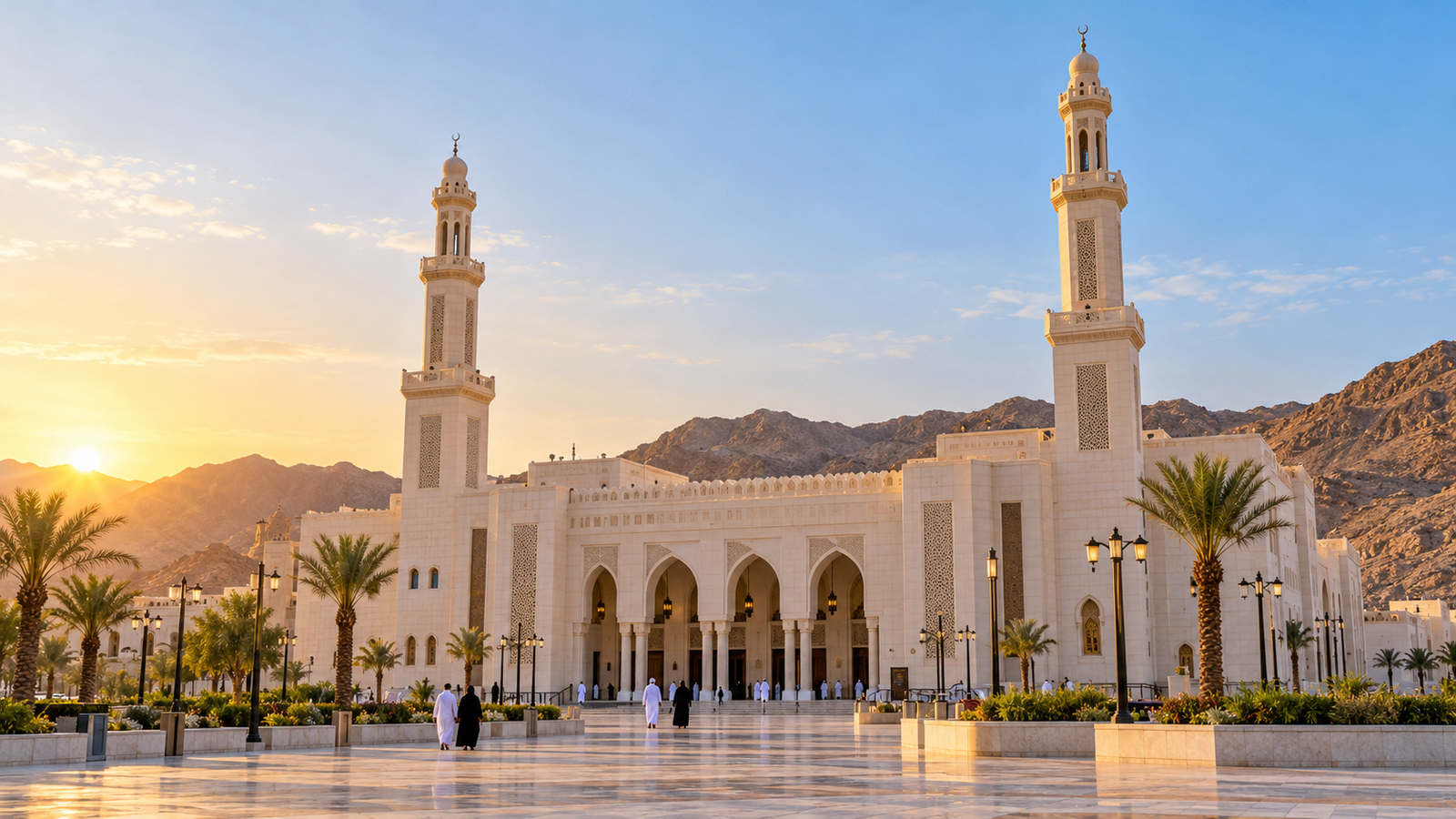
Masjid Aisha is the nearest well-known place outside Makkah’s Haram boundary where someone already staying in Makkah can enter ihram for a new Umrah. It stands in Taneem, about 7 km from Masjid al-Haram, and it is not the miqat that a traveller flying from the UK should rely on for a planned first Umrah.
You may also hear it called Masjid al-Taneem, Masjid Ayesha, Masjid e Aisha or Masjid e Ayesha.
What Is Masjid Aisha?
Masjid Aisha is a mosque in the Taneem district of Makkah, on the road towards Madinah. Taneem lies outside the boundary of the Haram, although it remains part of the wider city of Makkah.
That boundary is the reason pilgrims go there. A person already inside the Haram who wants to begin a separate Umrah must first go out to the area known as al-Hill. Masjid Aisha is the closest familiar place used for this purpose. Saudi Arabia’s official Nusuk information identifies it as one of the places from which Makkah residents and others enter ihram for Umrah.
You will often see the mosque described as a “miqat”. That is useful everyday language, but it needs one qualification: Masjid Aisha is the boundary station commonly used by people beginning a new Umrah from within Makkah. It does not replace the route-based miqat that an arriving pilgrim must observe before reaching Jeddah or Makkah.
Why Is It Called Masjid Aisha?
The name comes from Aisha bint Abi Bakr (RA), the wife of the Prophet Muhammad (peace and blessings be upon him).
During the Farewell Pilgrimage, Aisha (RA) was unable to complete the Umrah she had originally intended because of menstruation. After Hajj, the Prophet (peace and blessings be upon him) instructed her brother, Abd al-Rahman ibn Abi Bakr (RA), to take her to Tan’im so that she could enter ihram there and perform Umrah. This event is recorded in Sahih al-Bukhari 1784.
The mosque later took her name because it stands at the place associated with that journey. An official Saudi account states that the mosque was first built in 240 AH (854 CE) at the site where she assumed ihram.
The present mosque serves worshippers and marks the place from which Aisha (RA) began that Umrah. The religious basis comes from the event at Tan’im, not from the later building itself.
Who Uses Masjid Aisha and When?
Masjid Aisha is mainly used by:
- Residents of Makkah who want to perform Umrah.
- Visitors staying in a hotel inside the Haram boundary who decide to perform another Umrah.
- Pilgrims whose group leader or scholar has confirmed that they need to leave the Haram boundary before beginning their Umrah.
It is not the correct starting point for every pilgrim travelling to Makkah.
If you are flying directly from the UK to Jeddah
If you intend to perform Umrah when you fly to Jeddah, prepare before the aircraft reaches the miqat. The Saudi Ministry of Hajj and Umrah says that a passenger whose first arrival is Jeddah should wear the ihram clothing and make the intention on board when the aircraft announces that it is passing the miqat.
Do not land in Jeddah and treat Masjid Aisha as a substitute. The aircraft’s applicable miqat depends on its route; it will not always be Qarn al-Manazil. Follow the onboard announcement and your organiser’s guidance.
If you travel to Makkah from Madinah
Pilgrims leaving Madinah for Makkah normally enter ihram at Dhul Hulayfah, widely known as Bir Ali. The route-based miqats, including Dhul Hulayfah for those coming through Madinah, are set out in Sahih al-Bukhari 1526.
If you want to perform another Umrah
The majority of scholars allow another Umrah during the same journey. Scholars differ over repeatedly performing several Umrahs in one visit. Treat this as a fiqh question, not a holiday target; ask a trusted scholar if unsure.
How to Get to Masjid Aisha from the Haram
The official published distance is about 7 km from the Grand Mosque. Your pickup point and road restrictions around Masjid al-Haram can make the journey longer than the map suggests.
Taxi or private car
For most hotel guests, a taxi or ride-hailing car is simplest. Ask for Masjid al-Taneem or Masjid Aisha on Madinah Road, and agree whether the driver will wait.
Private operators checked on 19 October 2026 advertised a return journey with waiting at roughly SAR 100 to SAR 150 for a standard car. This is not an official tariff; street and app prices differ. Confirm that the quote includes waiting and return.
Makkah Bus
Makkah Bus Route 12 serves the stop named Ayesha Mosque from Terminal 1, Jabal Al Ka’bah, according to the Royal Commission’s published route timetable. Routes and departure times can change, so check the official journey planner or Makkah Bus app before leaving.
| Transport | Estimated price | Journey time | Best for |
|---|---|---|---|
| Taxi | SAR 100–150 (round trip, driver waits) | 15–20 min each way | Direct travel |
| Bus | SAR 4 | 30–40 min | Budget travellers |
| Private car with driver | SAR 150–200 (round trip) | 15–20 min each way | Families and groups |
Hotel transport or a Ziyarat tour
Some groups include Masjid Aisha on a Makkah Ziyarat visit. Do not assume that a hotel shuttle goes there; ask whether the coach waits while passengers change and pray.
What to Do When You Arrive
The easiest way to avoid confusion is to separate preparation, prayer and entry into ihram.
1. Prepare before leaving your hotel
You may wash, make wudu and put on the ihram clothing before travelling. For men, this means the two ihram cloths. Women continue in their normal modest Islamic dress; there is no separate white uniform for women.
Putting on the clothing does not by itself place you in the state of ihram. For an Umrah beginning from inside Makkah, wait until you have reached the area outside the Haram boundary before making the intention and beginning the talbiyah.
Masjid Aisha has separate facilities for men and women, including changing areas. Arriving prepared saves time.
2. Enter the mosque and pray if appropriate
If it is an appropriate time to pray, you may offer two rak‘ahs as Tahiyyat al-Masjid, the normal greeting of a mosque. Sahih Muslim 714b records the instruction to pray two rak‘ahs before sitting.
Two rak‘ahs are not a condition of ihram. Scholars differ over a distinct recommended ihram prayer; another view connects the prayer to an obligatory salah, wudu or greeting the mosque. Missing it does not prevent ihram.
If the congregational prayer is beginning, join it rather than starting a separate voluntary prayer.
3. Make the intention for Umrah
Niyyah is the settled intention in your heart to begin Umrah. It does not require a long speech. The Saudi Ministry guide gives the following wording when entering the rite:
Arabic: لَبَّيْكَ اللَّهُمَّ عُمْرَةً
Transliteration: Labbayka Allahumma ‘umratan.
Meaning: Here I am, O Allah, for Umrah.
Make this intention after you are outside the Haram boundary, not while you are still in your hotel inside it.
4. Begin the talbiyah
Then recite the talbiyah:
Arabic:
لَبَّيْكَ اللَّهُمَّ لَبَّيْكَ، لَبَّيْكَ لَا شَرِيكَ لَكَ لَبَّيْكَ، إِنَّ الْحَمْدَ وَالنِّعْمَةَ لَكَ وَالْمُلْكَ، لَا شَرِيكَ لَكَ
Transliteration:
Labbayka Allahumma labbayk. Labbayka la sharika laka labbayk. Inna al-hamda wa al-ni‘mata laka wa al-mulk. La sharika lak.
Meaning:
Here I am, O Allah, here I am. Here I am; You have no partner; here I am. All praise, blessing and sovereignty belong to You. You have no partner.
This wording is recorded in Sahih al-Bukhari 1549. Continue the talbiyah on the journey back to Masjid al-Haram, stopping when you begin tawaf.
There is no verified special surah, dua or “Masjid Aisha reading” that every pilgrim must recite. Pray, make personal dua and begin the talbiyah without inventing a ritual for the location.
5. Return to Masjid al-Haram and complete Umrah
Once you have made the intention and begun the talbiyah, the restrictions of ihram apply. Return to the Haram to complete tawaf, sa‘i, and the cutting or shortening of the hair.
Tips Before You Go
-
- Go prepared. Carry your ihram clothing if you are not already wearing it, a small bag, easy-to-identify sandals, your phone and your hotel card.
- Avoid unnecessary midday heat. The mosque is listed as open 24 hours, so early morning or evening may be more comfortable. Access arrangements can still change during major crowd-control operations.
- Expect crowds in Ramadan and the Hajj period. Official Saudi information says the mosque receives pilgrims throughout the year, with heavier traffic during peak seasons.
- Price the return, not just the outward ride. Make sure your driver understands whether you need waiting time and where you want to be dropped near the Haram.
- Use a registered service. If travelling independently, share your journey details with a companion and keep enough battery and mobile data for the return.
- Do not rush into a second Umrah through exhaustion. You are beginning a full act of worship, not collecting a visit on a sightseeing list.
Masjid Aisha is one of several historically significant locations covered in our
guide to the top Ziyarat places in Makkah.
Frequently Asked Questions About Masjid Aisha
Is Masjid Aisha the same as Masjid al-Taneem?
Yes. Masjid Aisha, Masjid Ayesha and Masjid al-Taneem are names used for the same mosque in the Taneem area of Makkah.
Can I perform Umrah more than once from Masjid Aisha?
The majority of scholars permit another Umrah during the same journey if you go outside the Haram boundary and enter ihram again. Scholars differ about frequently repeating Umrah within one visit, so seek guidance for your circumstances rather than assuming that more is always better.
How far is Masjid Aisha from Masjid al-Haram?
An official Saudi source places it about 7 km from the Grand Mosque. Road time depends on your hotel, pickup point, traffic and restrictions around the Haram.
Do I enter ihram at Masjid Aisha when flying from the UK?
Not for a planned first Umrah when flying directly to Jeddah. Prepare on the aircraft and enter ihram when the plane reaches the applicable miqat, following the announcement. If you first stay in Madinah, you normally use Dhul Hulayfah when leaving for Makkah.
What should a woman travelling independently do?
Use the separate women’s prayer and changing facilities, book a registered taxi or ride-hailing car, keep your hotel details with you and share the trip with somebody you trust. If you are with an organised Umrah group, ask whether they provide a coach or companion arrangement.
Questions about a mahram or an individual religious circumstance should go to a trusted scholar rather than a travel blog.
Is there a specific prayer to read at Masjid Aisha?
There is no special prayer or surah tied to Masjid Aisha. You may pray the general two-rak‘ah greeting of the mosque where appropriate, then make your intention and recite the talbiyah. The two rak‘ahs are not a condition for ihram.
Is Masjid Aisha open 24 hours?
The official Discover Makkah visitor listing gives 24-hour visiting. Check locally during Hajj, Ramadan or emergency crowd controls because access and transport arrangements may change even when the mosque remains open.
Before leaving your hotel, confirm that Taneem is the right boundary point for your situation, save the mosque pin and arrange the return fare. That ten-minute check prevents the most serious mistake: using Masjid Aisha when an earlier route-based miqat applied.
If you are planning your journey from Britain, explore our
Umrah packages from the UK
for help arranging flights, accommodation and transport.

