 Blog
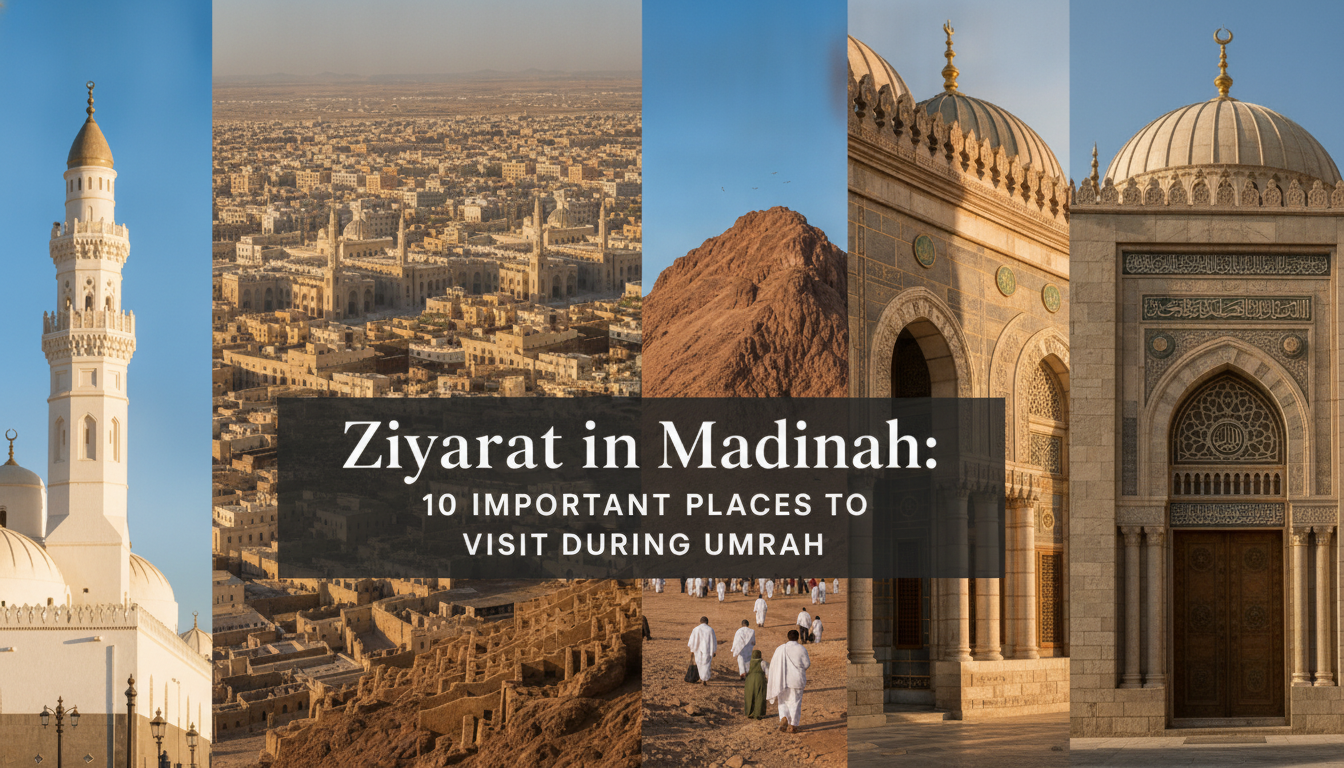
BlogZiyarat in Madinah: 10 Important Places to Visit During Umrah
Ziyarat in Madinah means visiting places connected with the life of Prophet Muhammad صلى الله عليه وسلم, his companions and the early Muslim community. It is not a compulsory part of Umrah, but many pilgrims include it because it helps them understand the history of Madinah with more clarity and respect.
If you are travelling from the UK for Umrah, the main Ziyarat places in Madinah usually include Masjid an-Nabawi, Rawdah, Jannatul Baqi, Masjid Quba, Mount Uhud, Masjid al-Qiblatain and the Khandaq area. Some places are close to the Prophet’s Mosque, while others are better visited as part of a planned Madinah Ziyarat route.
Below is a practical and respectful guide to the most important places to know before you travel.
What Is Ziyarat in Madinah?
Ziyarat simply means “visit”. In Madinah, it usually refers to visiting mosques, cemeteries, mountains and historical locations connected to the Seerah of the Prophet صلى الله عليه وسلم and the lives of the Sahabah.
It is important to keep the right understanding:
- Ziyarat is not one of the pillars of Umrah.
- It should not replace obligatory prayers or the main purpose of your pilgrimage.
- Visiting historical places can be beneficial when done with respect, knowledge and correct belief.
- Specific religious rewards should only be claimed where there is reliable evidence.
A good Ziyarat visit is not about rushing through the longest possible list. It is about understanding where you are, what happened there, and what lessons can be taken from the lives of those who came before us.
Main Ziyarat Places in Madinah
| Place | Why pilgrims visit |
|---|---|
| 1. Masjid an-Nabawi | The Prophet’s Mosque and centre of Madinah |
| 2. Rawdah | A blessed area inside Masjid an-Nabawi |
| 3. Jannatul Baqi | Historic cemetery beside Masjid an-Nabawi |
| 4. Masjid Quba | The first mosque established in Islam |
| 5. Mount Uhud and Martyrs of Uhud | Site connected with the Battle of Uhud |
| 6. Masjid al-Qiblatain | Associated with the change of Qiblah |
| 7. The Seven Mosques / Khandaq area | Linked to the Battle of the Trench |
| 8. Masjid al-Ghamamah | Historic mosque near Masjid an-Nabawi |
| 9. Masjid al-Jum’ah | Associated with the first Friday prayer after Hijrah |
| 10. Well of Uthman / Bir Rumah | Historic well linked to Uthman ibn Affan رضي الله عنه |
1. Masjid an-Nabawi
Masjid an-Nabawi is the heart of Madinah and the most important place most pilgrims visit after arriving in the city. It was established by the Prophet صلى الله عليه وسلم after the Hijrah and remains one of the most significant mosques in Islam.
For pilgrims, time in Masjid an-Nabawi should not feel like sightseeing. It is a place for prayer, Qur’an, salawat, reflection and calm. Many visitors plan their Madinah stay around praying as many salah as possible in the mosque.
Because the area can be busy, especially around prayer times, it is sensible to give Masjid an-Nabawi its own time rather than trying to fit it into a rushed city tour.
2. Rawdah
The Rawdah is the area between the house of the Prophet صلى الله عليه وسلم and his pulpit inside Masjid an-Nabawi. The Prophet صلى الله عليه وسلم said: “Between my house and my pulpit there is a garden from the gardens of Paradise” — recorded in Sahih al-Bukhari.
Because of its significance, many pilgrims hope to pray there during their stay in Madinah. Access is controlled and may require booking through the official permitted process, so it should be planned separately from a general Ziyarat route.
A taxi, coach or private tour cannot guarantee Rawdah entry. If Rawdah is important to your itinerary, check the current official process before travelling and allow flexibility in your schedule.
3. Jannatul Baqi
Jannatul Baqi, also known as Baqi al-Gharqad, is the historic cemetery next to Masjid an-Nabawi. It is the resting place of many members of the Prophet’s family, companions and early Muslims.
A visit to Jannatul Baqi is a reminder of the temporary nature of this life and the honour of those who supported Islam in its earliest generations. Visitors should keep their voices low, follow local instructions, avoid inappropriate photography and maintain the correct etiquette when visiting graves.
This is best planned alongside your time at Masjid an-Nabawi rather than as part of an outer-city driving tour.
4. Masjid Quba
Masjid Quba is one of the most visited Ziyarat places in Madinah. It is widely recognised as the first mosque established in Islam. Saudipedia describes Quba Mosque as the first mosque built in Islam and one of the important historical sites of Madinah.
There is also a specific virtue connected with praying there. A narration in Sunan Ibn Majah states that whoever purifies himself at home, goes to Masjid Quba and offers prayer there will have a reward like that of Umrah.
Because of this, many pilgrims like to visit Masjid Quba calmly, pray two rak’ahs and spend a short time reflecting. It is usually one of the main stops on a Madinah Ziyarat route.
5. Mount Uhud and Martyrs of Uhud
Mount Uhud is connected with the Battle of Uhud, one of the major events in early Islamic history. Near the mountain is the area associated with the martyrs of Uhud, including Hamza ibn Abdul Muttalib رضي الله عنه.
The Prophet صلى الله عليه وسلم said about Uhud: “This is a mountain that loves us and is loved by us,” recorded in Sahih al-Bukhari.
A visit to Uhud is not only about seeing the mountain. It is an opportunity to remember sacrifice, obedience, patience and the lessons of the Battle of Uhud. Visitors should be respectful, avoid unsafe climbing, follow signs and keep children close, especially in hot weather or crowded periods.
6. Masjid al-Qiblatain
Masjid al-Qiblatain is associated with the change of the Qiblah from Jerusalem towards the Kaaba in Makkah. The Qur’an mentions the command to turn towards al-Masjid al-Haram in Surah al-Baqarah 2:144.
The mosque’s name means “the mosque of the two Qiblahs”. It is one of the most commonly visited Madinah Ziyarat places because it marks a major moment in the history of Muslim worship.
For pilgrims, the lesson is clear: the early Muslims responded to Allah’s command with obedience and trust.
7. The Seven Mosques and Khandaq Area
The Seven Mosques area is linked with the Battle of the Trench, also known as Ghazwat al-Khandaq. The area includes historically known mosques such as Masjid al-Fath and other small mosques associated with the wider Khandaq location.
Saudipedia explains that the Seven Mosques are connected with the Battle of the Trench and that some historians include Masjid al-Qiblatain as part of the wider visited route because it is nearby.
This area is often included in a half-day Ziyarat route with Quba, Qiblatain and Uhud. The main benefit of visiting is understanding the strategic patience and unity shown by the Muslim community during a difficult period.
8. Masjid al-Ghamamah
Masjid al-Ghamamah is located near Masjid an-Nabawi. It is historically associated with outdoor prayers during the time of the Prophet صلى الله عليه وسلم, including Eid prayer and prayer for rain according to common historical accounts.
Because it is close to the central mosque area, some pilgrims pass it without realising its history. If you are already walking around the area near Masjid an-Nabawi, it can be included as a short, respectful stop.
As with all historical mosques, avoid treating the building itself as a place with invented rituals. Visit with respect, pray if appropriate, and focus on learning.
9. Masjid al-Jum’ah
Masjid al-Jum’ah is associated with the first Friday prayer performed by the Prophet صلى الله عليه وسلم after the Hijrah. It is often visited together with Masjid Quba because the two are relatively close within many Ziyarat routes.
This stop is usually brief, but it gives pilgrims a chance to reflect on the establishment of communal Muslim life in Madinah. Friday prayer was not just a gathering; it became part of the rhythm of the Muslim community.
If you are travelling with elderly relatives or children, this is the type of site where a short, calm visit is usually more suitable than a long stop.
10. Well of Uthman / Bir Rumah
The Well of Uthman, also known as Bir Rumah, is linked to Uthman ibn Affan رضي الله عنه. It is remembered because of his generosity in providing access to water for the people of Madinah.
Saudipedia lists the Well of Uthman among the historical sites of Madinah and notes its importance as a water source for residents and visitors over many years.
This site may not be included in every standard Ziyarat tour, but it is valuable for pilgrims interested in the history of charity, public service and the practical needs of the early Muslim community.
Central Ziyarat Sites vs Outer-City Ziyarat Route
One of the most useful ways to plan Ziyarat in Madinah is to separate the places into two groups.
Places to Plan Around Masjid an-Nabawi
These are best visited separately, not rushed inside a driving tour:
- Masjid an-Nabawi
- Rawdah
- Jannatul Baqi
- Masjid al-Ghamamah
- Nearby historic mosques, where accessible
Places Suitable for a Planned Ziyarat Route
These are commonly visited by taxi, coach or private transport:
- Masjid Quba
- Masjid al-Jum’ah
- Masjid al-Qiblatain
- Seven Mosques / Khandaq area
- Mount Uhud and Martyrs of Uhud
- Well of Uthman, if included and accessible
This structure helps avoid one of the most common mistakes: trying to visit Rawdah, Baqi, Quba, Uhud and every other site in one rushed outing.
How Long Does Ziyarat in Madinah Take?
A short Madinah Ziyarat route can take a few hours if it focuses on the main outer sites such as Quba, Qiblatain, Khandaq and Uhud. A slower visit with family, elderly travellers or extra stops may need more time.
For UK pilgrims, it is wise to avoid scheduling Ziyarat immediately after a tiring flight or long transfer. Madinah deserves calm. If your package includes several nights in Madinah, plan Ziyarat after you have rested and settled into your prayer routine at Masjid an-Nabawi.
Is Ziyarat Compulsory During Umrah?
No. Ziyarat in Madinah is not compulsory during Umrah.
Umrah has its own required acts, while Ziyarat is a voluntary visit to places of Islamic and historical significance. It can add meaning to your journey, but it should not be treated as a condition for a valid Umrah.
The best approach is to complete your worship properly, then visit historical places with knowledge, humility and respect.
Practical Tips for UK Pilgrims Visiting Madinah
- Do not overpack your itinerary.
Many pilgrims want to visit every site they have heard about. In reality, a shorter list visited calmly is often more beneficial than a long list completed in a rush. - Check current local arrangements.
Access, visiting times, road routes and crowd controls can change. This is especially important for Rawdah and Jannatul Baqi. - Keep the right intention.
Ziyarat is for learning, remembrance and reflection. Avoid superstitious practices or believing that every location has a specific virtue unless that is supported by reliable evidence. - Consider your group’s needs.
Families with children, elderly pilgrims and wheelchair users may need a slower route. Ask about transport arrangements in advance if mobility is a concern. - Keep Makkah and Madinah Ziyarat separate.
If your Umrah package includes time in both cities, plan each city properly. Dar Al Haram has a separate guide to the main Ziyarat places in Makkah, which can be used alongside this Madinah guide.
Planning Umrah from the UK with Dar Al Haram Travels
For many UK pilgrims, Madinah is one of the most memorable parts of the Umrah journey. A well-planned package can make it easier to balance worship, rest, transport and Ziyarat without feeling rushed.
Dar Al Haram Travels helps UK pilgrims arrange Umrah packages with flights, hotels, transfers and guidance based on your travel needs. If you want time for Madinah Ziyarat, mention this when discussing your itinerary so the trip can be planned around your pace, family size and priorities.
You can explore Dar Al Haram’s Umrah packages from the UK or speak to the team for help choosing a suitable travel plan.
FAQs About Ziyarat in Madinah
What are the main Ziyarat places in Madinah?
The main Ziyarat places in Madinah include Masjid an-Nabawi, Rawdah, Jannatul Baqi, Masjid Quba, Mount Uhud, the Martyrs of Uhud, Masjid al-Qiblatain, the Seven Mosques, Masjid al-Ghamamah, Masjid al-Jum’ah and the Well of Uthman.
How many Ziyarat places are there in Madinah?
There is no fixed number. Madinah has many mosques, cemeteries, wells, mountains and historical areas connected with Islamic history. Most pilgrims focus on around 8–10 main places during a short visit.
Can Madinah Ziyarat be done in one day?
Yes, the main outer-city sites such as Masjid Quba, Qiblatain, Khandaq and Uhud can often be visited in one planned outing. However, Rawdah, Masjid an-Nabawi and Jannatul Baqi should be planned separately because they depend on prayer times, access and crowd arrangements.
Is Ziyarat required for Umrah?
No. Ziyarat is not required for Umrah. It is a voluntary visit to places of Islamic history and reflection. It should not be treated as a compulsory ritual.
What is the difference between Makkah and Madinah Ziyarat?
Makkah Ziyarat focuses on places connected with revelation, early persecution, Hijrah preparation and Hajj/Umrah locations. Madinah Ziyarat focuses more on the Prophet’s community, major battles, historic mosques, cemeteries and the development of Muslim society after Hijrah.

