 Blog
BlogWhat Mistakes To Avoid During Hajj
There is a specific kind of silence that falls over a pilgrim when they first glimpse the Kaaba. It’s a mix of “I can’t believe I’m finally here” and “Am I worthy of being here?” For many of us, Hajj is the culmination of years of saving, months of praying, and a lifetime of yearning.
But here is the truth no one tells you in the glossy travel brochures: Hajj is a beautiful, chaotic, and grueling test of your character. In the 2026 season, as we face record-breaking temperatures and massive crowds, it is easy to let the “logistics” swallow your “spirituality.” To ensure your pilgrimage is Mabrur (accepted), you have to walk a sacred tightrope. You must balance the technical rules with a heart that stays soft, even when your feet are blistered and the bus is five hours late.
Here are 12 critical pitfalls—spiritual, physical, and emotional—that can “break” the essence of your journey, and how to navigate them with grace.
1. Entering “Robot Mode” (The Niyyah Mistake)
We often get so caught up in the “Uniform of Hajj”—the white towels of Ihram—that we forget the soul of the act.
The Human Error:
Treating the Meeqat boundary like an airport security check. You’re just going through the motions.
The Fix:
Stop. Breathe. Before you cross that line, have a conversation with your Creator. Why are you here? If your intention isn’t set, you’re just wearing towels and traveling. Your Niyyah is the anchor that keeps your Hajj from drifting into a mere vacation.
2. The Fragrance “Slip-Up”
It sounds minor, but in the state of Ihram, you are stripped of the luxuries of the self, including scents.
The Struggle:
You’re sweaty, tired, and reach for that scented wet wipe or the hotel’s floral soap.
The Reality:
These small comforts are “prohibitions.”
Pro-Tip:
Buy your unscented kit early. Use it at home first. When you smell “nothing” during Hajj, let that be a reminder that you are in a state of raw, unadorned devotion.
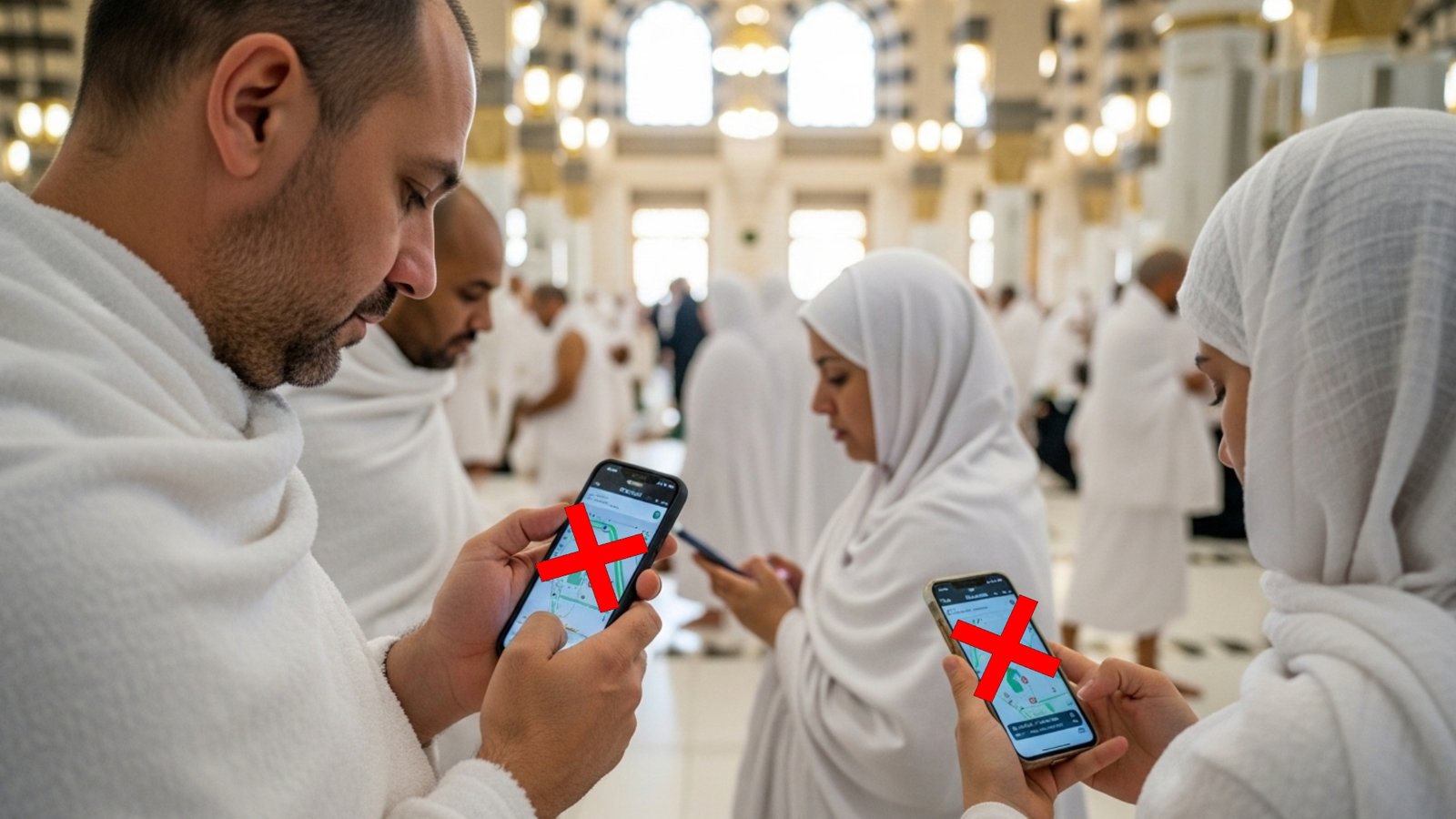
3. The “Digital Hijacking” of Your Heart
We live in a world of “pics or it didn’t happen.” But Hajj is the one place where you don’t need to prove your presence to anyone but Allah.
The Pitfall:
Trying to find the perfect angle for a selfie while people are pouring their hearts out in tears behind you.
The Human Cost:
Every time you look through a screen, you disconnect from the divine energy of the moment.
The Challenge:
Keep your phone for emergencies and logistics. Capture the memories with your soul, not your pixels. Your followers don’t need to see your Tawaf; your Creator already does.
4. The “Arafat Boundary” Anxiety
Arafat is the day of forgiveness. It is the heart of Hajj.
The Mistake:
Following the crowd instead of the signs. In the heat and exhaustion, some pilgrims settle for a spot just outside the marked boundaries of the Plain of Arafat.
The Consequence:
If you aren’t within the lines, your Hajj hasn’t technically started.
The Human Fix:
Look for the giant yellow signposts. Don’t just sit where it’s comfortable; sit where it counts.
5. Turning Symbolism into Aggression (The Jamarat)
The stoning of the pillars is a symbolic “No” to your own inner demons.
The Scene:
You see people screaming, throwing shoes, and pushing the elderly to get closer.
The Truth:
Shaytan isn’t inside that concrete pillar; he’s in the anger you feel toward your brother who just stepped on your foot.
The Way Forward:
Throw your pebbles with a whisper, not a shout. If you lose your temper at the Jamarat, the “devil” has already won that round.
6. The “Three Forbidden Tongues”
The Quran warns against Rafath (indecent speech), Fusuq (sin), and Jidal (arguing).
The Reality Check:
It is easy to be a saint in a quiet Masjid. It is nearly impossible to be a saint when someone steals your spot in the tent or the bathroom line is 40 people deep.
The Strategy:
Hajj is an endurance sport for your patience. When the urge to complain rises, swallow it. Silence is often the greatest form of worship in Mina.
7. The Dehydration Trap: A Mercy to Your Body
In the 2026 heatwave, temperatures will be unforgiving.
The Mistake:
“I won’t drink water because I don’t want to wait in the toilet line.”
The Risk:
This isn’t just a logistical choice; it’s a health crisis. Heatstroke can end your Hajj faster than any ritual error.
The Human Advice:
Your body is a trust (Amanah). Drink. Wait in the line. Use that waiting time for Dhikr.
8. Cutting Corners on the “Cut”
At the end of the rituals, we trim or shave our hair to signal a new beginning.
The Shortcut:
Snapping a tiny scissors-width of hair just to get it over with.
The Better Way:
Whether you shave or trim, do it with the intention that you are shedding your old sins with every lock of hair that falls.
9. Rushing the Quiet Moments of Muzdalifah
Muzdalifah is meant to be a night under the stars, a moment of raw connection.
The Mistake:
Viewing it as a “layover” and trying to rush back to the city the second the clock hits midnight.
The Fix:
Lean into the discomfort. Sleeping on the ground in Muzdalifah is the great equalizer. Embrace the humility.
10. The Farewell That Wasn’t
The Tawaf al-Wadaa (Farewell Tawaf) is your final “Goodbye.”
The Pitfall:
Performing the Tawaf and then heading back to the mall for three hours of souvenir shopping.
The Protocol:
Let the House of Allah be the last thing your eyes see before you head to the airport.
11. Becoming the “Ritual Police”
You will see people praying differently, dressing differently, and crying differently.
The Mistake:
Judging others or starting debates about Fiqh (jurisprudence) in the middle of the Haram.
The Mindset:
You are there to fix yourself, not the Ummah. Focus on your own “Tightrope.”
12. Returning as the Same Person
The biggest tragedy of Hajj is a pilgrim who returns with a “Hajji” title but the same old heart.
The Human Goal:
If you come back and you’re still harsh with your family, dishonest in your business, or arrogant in your speech, did you really leave Makkah?
The Success Metric:
A successful Hajj is invisible. It’s found in the way you treat people after you take the Ihram off.
Final Thoughts: The Journey of a Lifetime
Hajj is not a performance; it’s a transformation. It’s okay to be tired. It’s okay to cry. It’s even okay to feel overwhelmed. Just don’t let the “To-Do” list distract you from the “To-Be.”
Be patient. Be kind. Be present.
For Umrah packages, please visit us


